Signotaur Timestamp Action
The Signotaur Timestamp action allows you to timestamp files. This action provides various options to configure the timestamping process, including specifying the files to be timestamp, the timestamp services, and the algorithm.
The Signotaur Timestamp action in Continua is a wrapper around the Signotaur client tool command line. If you're having trouble using the Signotaur Timestamp action, please refer to the Command Line Reference.
Signotaur Timestamp
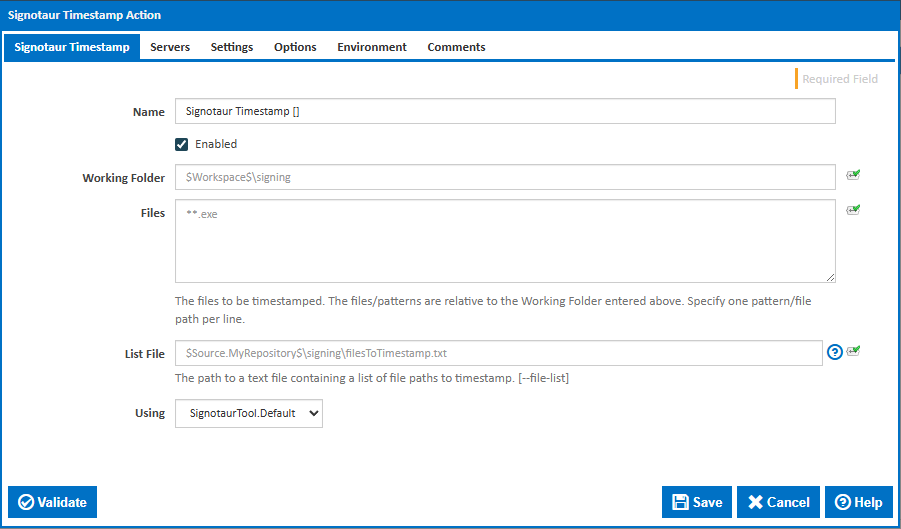
Name
A friendly name for this action (will be displayed in the actions workflow area).
Enabled
Determines if this action will be run within the relevant stage.
Working Folder
The folder where the files to be timestamped are located. This can be an absolute path or a path relative to the build workspace.
Files
Specify the file(s) to be timestamped. You can specify an exact file path or you can use ANT pattern matching to specify multiple files. Each file path or pattern must be entered on a new line. You can exclude files by prefixing the file name or pattern with a dash. e.g -*.ignore. Exclude patterns always take precedence over include patterns.
More information about pattern wild cards can be found on the Ant Pattern Usage page.
List File
The path to a text file containing a list of files to timestamp. This is helpful for timestamping multiple files at once without specifying each one in the command line. *[--file-list]
Using
The Using drop down is populated with any property collector whose namespace matches the pattern defined by the Signotaur action. The pattern for this action is ^SignotaurTool(?:\.|$). If you create a property collector for this action, make sure you select the Path Finder PlugIn type and give it a name that will match the pattern above. For more in-depth explanations on property collectors see Property Collectors.
Alternatively, you can select the Custom option from the Using drop down list and specify a path in the resulting input field that will be displayed. Please read Why it's a good idea to use a property collector before using this option.
Servers
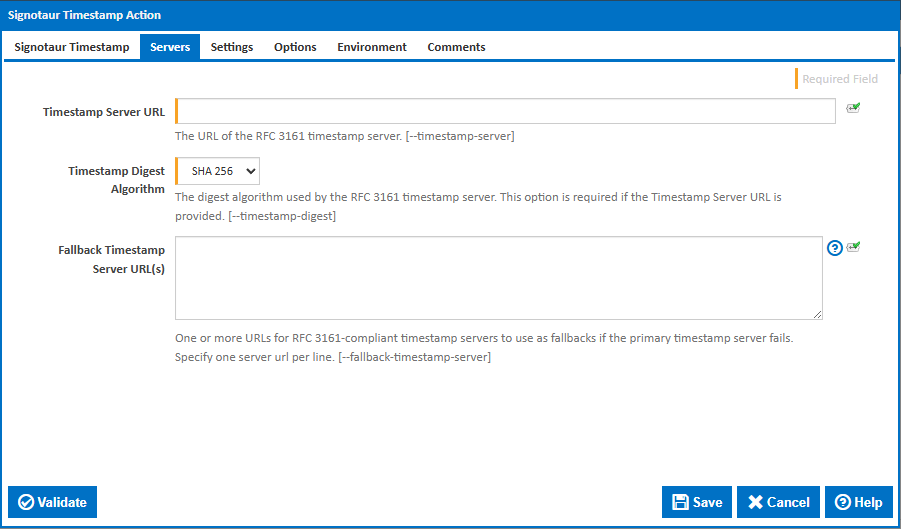
Timestamp Server URL
The URL of the RFC 3161 timestamp server. Time stamping is important for proving when a file was signed. [--timestamp-server]
Timestamp Digest Algorithm
The digest algorithm used by the RFC 3161 timestamp server. This option is required if the Timestamp Server URL is provided. [--timestamp-digest]
Fallback Timestamp Server URL(s)
One or more URLs for RFC 3161-compliant timestamp servers to use as fallbacks if the primary timestamp server fails. Specify one server url per line. [--fallback-timestamp-server]
Settings
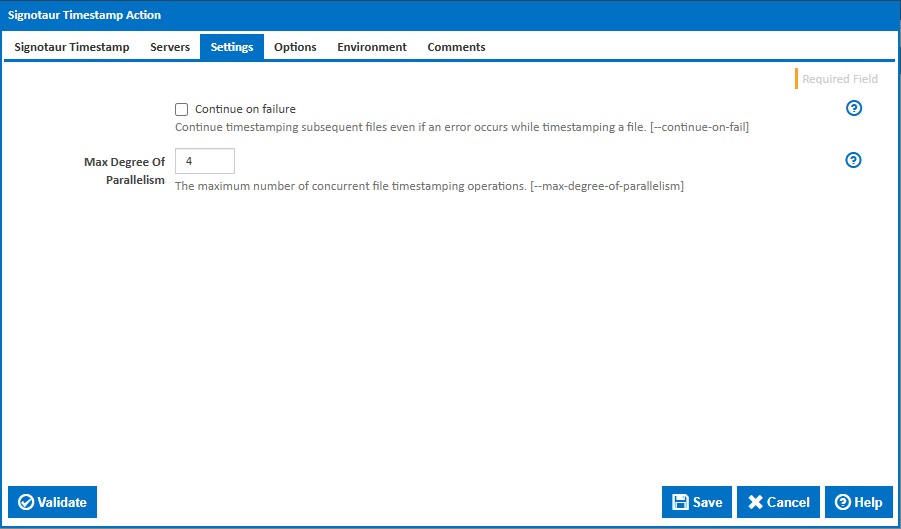
Continue on failure
Continue timestamping subsequent files even if an error occurs while timestamping a file. This option is useful for batch timestamping scenarios where you want to attempt to timestamp all files regardless of individual failure. [--continue-on-fail]
Max Degree Of Parallelism
The maximum number of concurrent file timestamping operations. This setting allows you to control the degree of parallelism to optimize performance. The default value is 4, but you can adjust this based on the capabilities of your machine. [--max-degree-of-parallelism]
Options
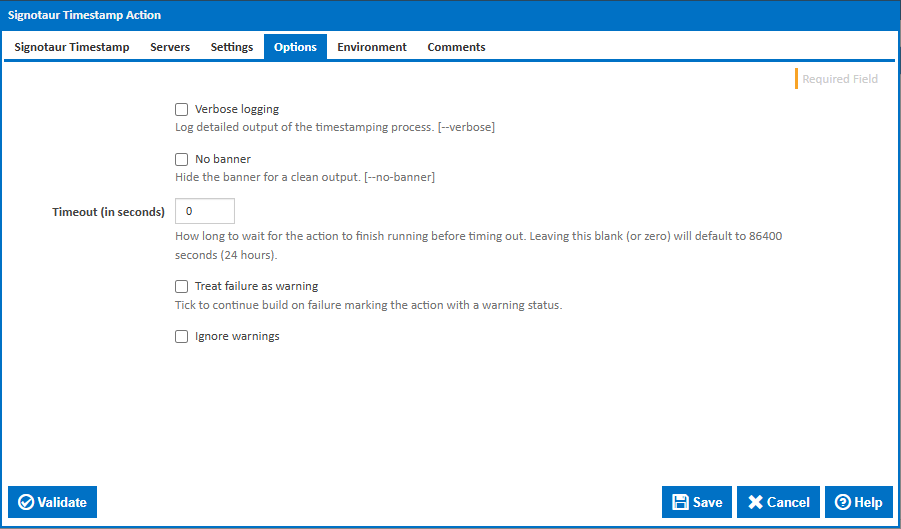
Verbose logging
Log detailed output of the timestamping process. [--verbose]
No banner
Hide the banner for a clean log output. [--nb]
Timeout (in seconds)
How long to wait for the action to finish running before timing out. Leaving this blank (or zero) will default to 86400 seconds (24 hours).
Treat failure as warning
Tick to continue build on failure marking the action with a warning status.
Ignore warnings
If this is ticked, any warnings logged will not mark the action with a warning status.
Environment
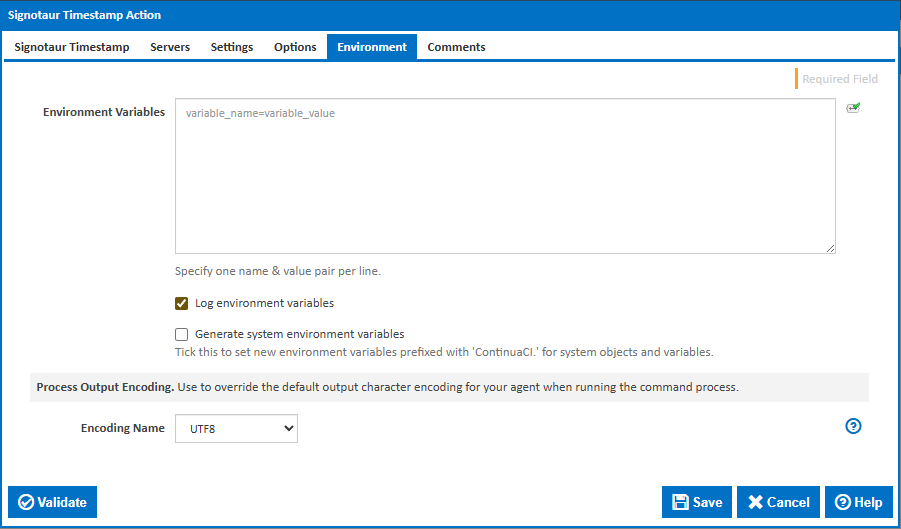
Environment Variables
Multiple environment variables can be defined - one per line. These are set before the command line is run.
Log environment variables
If this is ticked, environment variable values are written to the build log.
Generate system environment variables
Tick this checkbox to set up a list of new environment variables prefixed with 'ContinuaCI.' for all current system expression objects and variables.
Mask sensitive variable values in system environment variables
This checkbox is visible only if the 'Generate system environment variables' checkbox is ticked.
If this is ticked, the values of any variables marked as sensitive will be masked with **** when setting system environment variables. Clear this to expose the values.