Website Settings
The Website tab allows administrators to configure the public address at which the Signotaur server is reached. The hostname and port determine what Kestrel binds to, and are also used as the base for links in outbound emails (password reset, email verification, new-user welcome).
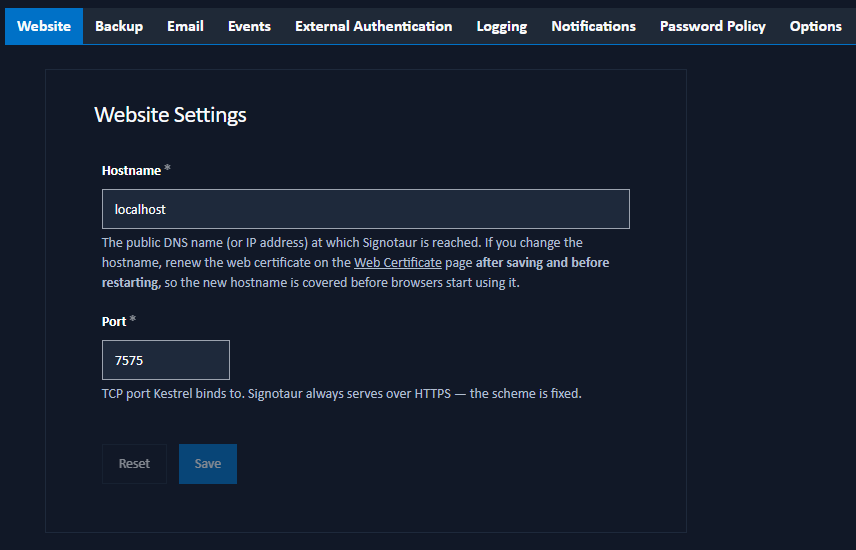
Configuration Options
Hostname: The public DNS name (or IP address) at which Signotaur is reached, for example
signotaur.example.com.Port: The TCP port Kestrel binds to for the web interface and signing API. The default is
7575. Valid range is 1–65535. A few ports are reserved for other protocols and cannot be opened by a browser; the field warns if you enter one, because the web interface would then be unreachable.
Signotaur always serves over HTTPS; the scheme is fixed and not configurable. The Internal CA's validation service can additionally listen on a plain-HTTP port of its own, set on the Validation Authority sub-tab of the Internal CA settings.
Saving Changes
Click Save to apply the new site URL. A confirmation dialog will appear to confirm the action.
A service restart is required for changes to this setting to take effect. Kestrel binds to the configured URL only at start-up, so after saving you will see an in-page reminder until the service is restarted.
The web TLS certificate is not managed here; it is configured on the Web Certificate page. If you change the hostname, the active web certificate will not automatically include the new hostname in its Subject Alternative Names. Renew or reissue the certificate from the Web Certificate page after saving the new Site URL and before restarting the service. Signotaur applies a renewed web certificate without a restart, so once it is reissued the cert will cover the new hostname by the time Kestrel rebinds. Renewing after the restart leaves a window in which browsers reaching the server via the new hostname see a certificate-mismatch error. The Web Certificate page itself may be unreachable until the cert is fixed. When the certificate's subject differs from the configured hostname, Signotaur adds the hostname to the SAN list automatically at the next issuance.
When the Internal CA's Validation Authority uses this server's address as its LAN base URL, it stores that address in every certificate it issues. Changing the address makes those URLs unreachable for certificates that have already been issued, so revocation checks against them fail.
Either keep the old address reachable, or reissue the affected certificates. To avoid the problem altogether, give the Validation Authority a dedicated stable name as its LAN base URL on the Internal CA settings, so it no longer follows this page.
Signotaur shows the same warning in the page while you edit, and only for the field that actually matters. Changing the Hostname always affects those URLs. Changing the Port affects them only when the validation URLs are on the website's port rather than the Validation Authority's own listen port.
A typo in the site URL will leave the server unreachable from a browser after restart. Recover by editing the configuration file directly, or by re-running the installer's configure command from the server host.
If the port is already in use when the service starts, Signotaur stops with a message naming the port. Free the port, or change it with server.exe configure --port <port> on the server host, then start the service again.